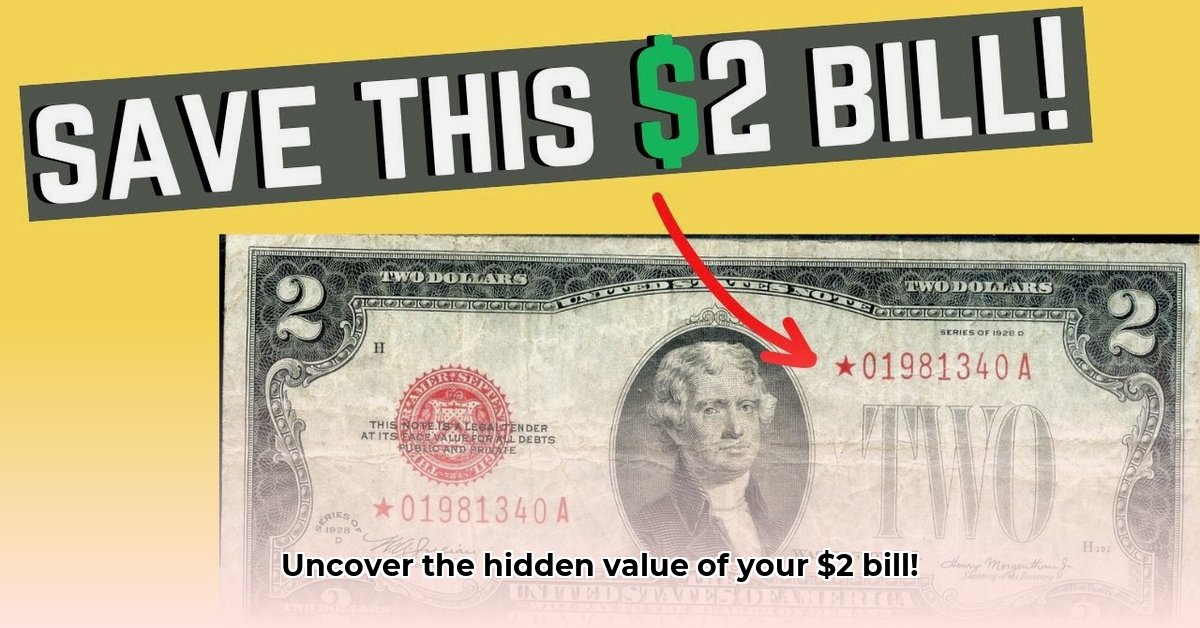
Understanding Your 1928 $2 Bill D Series
Discovering a 1928 $2 bill, especially one from the D series, is exciting! But its value isn't immediately apparent. This guide will help you determine its worth, whether you're a seasoned collector or a curious newcomer. We'll explore key features, grading, and pricing strategies to navigate the world of numismatics. For more on valuable currency, see this guide on 1990 half dollars.
What Makes Your 1928 $2 Bill D Series Valuable?
Several factors contribute to the value of your 1928 $2 bill D series. Let's examine them:
Key Identifying Features
The "D" after "1928" signifies its series. However, other features significantly impact value:
Star Notes: These banknotes (replace "banknotes" with "bills" for consistency) feature a star (*) replacing a damaged serial-number digit. These are more valuable due to their rarity.
Fancy Serial Numbers: Repeating numbers (e.g., 11111111), low numbers (e.g., 00000001), or patterns significantly increase value.
Size: Even minor size variations can affect a bill's worth. Accurate measurement is key.
Condition: The Cornerstone of Value
A bill's condition is paramount. Numismatists use grading systems, such as the one from the Paper Money Guaranty (PMG), to assess factors like wear and tear, creases, stains and overall cleanliness. A higher PMG grade correlates with higher value. A near-perfect bill will command a significantly higher price than a damaged one.
Rarity: The Economics of Collectibles
The rarity of specific 1928 $2 bill D series variations directly affects value. Less common bills are, generally, more valuable.
Pricing Discrepancies: Why Values Vary
Online valuations for 1928 $2 bills vary widely. This is because seemingly similar bills can have subtle differences in condition and features. A bill in good condition may be worth only slightly more than its face value, while one with a star note or a fancy serial number could be worth thousands. This highlights the importance of professional assessment for higher-value notes.
How to Determine Your Bill's Value: A Step-by-Step Guide
Follow these steps to assess your 1928 $2 bill D series:
Identify the Series: Confirm the presence of the "D" to verify the series.
Assess Condition: Meticulously examine the bill for damage. Compare your bill to images of graded bills online to estimate condition.
Check for Special Features: Look for star notes and fancy serial numbers.
Online Research (Use Caution): Online resources provide estimates, but remember that those values vary widely. Use reputable sources.
Professional Appraisal: For potentially high-value bills, professional numismatic appraisal is advisable to mitigate risks and obtain accurate pricing.
Risk Assessment and Mitigation
Understanding potential risks is crucial:
| Risk Factor | Probability | Impact | Mitigation |
|---|---|---|---|
| Counterfeit Bill | Moderate | Very High | Professional authentication, comparison with genuine images |
| Overvaluation by Sellers | High | Moderate | Independent appraisal, comparison across multiple reliable sources |
| Underestimation of Value | Low | Moderate | Meticulous research, expert advice |
| Damage/Deterioration Over Time | Moderate | High | Protective sleeves, acid-free storage |
| Market Fluctuations | Moderate | Moderate | Long-term investment perspective |
Key Takeaways: Understanding Value Drivers
- The value of a 1928 $2 bill hinges on its series, condition, and unique features (star notes, fancy serial numbers).
- Most circulated bills are worth around face value or slightly more, while exceptional notes with rare features can sell for thousands of dollars.
- Professional grading services from reputable sources like PMG are vital for accuracy and fair pricing.
- Understanding series variations, print runs, and potentially valuable features is key to determining a bill's true worth.
Advanced Considerations and Further Research
Exploring advanced aspects like plate position and red seals will enhance your knowledge. However, mastering the fundamentals is initially crucial. Consult reputable online resources like auction records for detailed information and up-to-date pricing. Remember, professional expertise is invaluable for accurate valuation.